
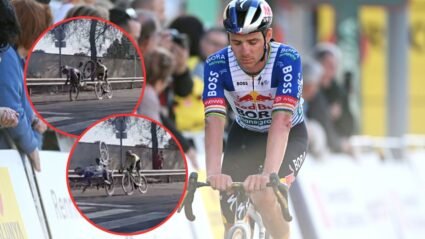
By now, you’ve seen the clip. Stage 3 of the 2026 Volta a Catalunya. Remco Evenepoel and Jonas Vingegaard, alone inside the final kilometer. Remco enters a roundabout, hits a pothole, shifts his hand position — and goes over the bars.
The cycling world moved on quickly. Pothole. Bad luck. Remco blamed his hand position. Jonas showed sportsmanship by waiting. End of story.
But I’ve watched the slow-motion replay dozens of times. And something doesn’t add up.
Remco’s rear wheel lifts clean off the ground — the unmistakable signature of a front brake fully locked. A pothole can knock your hands loose. A pothole cannot squeeze your brake lever.
So what did?
What Everyone Saw
The official explanation is straightforward: Remco was moving his hands to the drops when he hit an unmarked pothole. The impact jarred his grip, he lost control, and he crashed.
That’s true as far as it goes. But it’s incomplete.
Watch the replay carefully. His bike doesn’t just wobble. The rear wheel rises like he’s hit an invisible wall. That’s not a steering correction gone wrong. That’s a front brake engaged at maximum force — at 50+ km/h, mid-corner, with no time to react.
The Missing Question
Here’s what no interviewer asked and no commentator raised:
Why did a pothole lead to a full front brake lockup?
The assumption seems to be that Remco simply grabbed a handful of brake by accident. But Remco Evenepoel is not a novice. He has thousands of race hours and some of the finest bike-handling skills in the peloton. He doesn’t “accidentally” grab fistfuls of front brake.
Something else happened. And I believe it comes down to a recent, overlooked change: his groupset.
The Switch No One Is Talking About
When Remco moved to Red Bull-Bora-Hansgrohe for 2026, he changed more than his jersey. He switched from Shimano Dura-Ace Di2 — his groupset for years at Quick-Step and Soudal — to SRAM Red AXS.
On paper, both are world-class. But on the road, they feel fundamentally different.
| Feature | Shimano Dura-Ace Di2 | SRAM Red AXS |
|---|---|---|
| Lever feel | Heavier, progressive | Feather-light, immediate |
| Initial bite | Aggressive (“grabby”) | Linear, builds with pressure |
| Force to max braking | High | Low |
| Modulation | Good | Excellent |
Neither is “better.” But they are not interchangeable. And your hands know the difference — even if your conscious brain doesn’t.
The Muscle Memory Trap
Here’s the critical point that everyone has missed:
After years on Shimano, Remco’s braking reflex is calibrated to a specific force curve. When his brain says “hard brake now,” his hands automatically apply the amount of lever pressure that would produce maximum stopping power on a Shimano system.
But SRAM doesn’t need that much pressure. SRAM achieves full braking with significantly less lever force.
So what happens when a Shimano-trained rider grabs SRAM brakes at race speed?
The Two-Stage Over-Brake
I believe the crash unfolded in two stages — too fast for the naked eye, but visible in the physics of the bike:
Stage 1 — The Shimano Grab
Remco hits the pothole, his hands shift, and instinct takes over. He pulls the lever with the force that would deliver aggressive Shimano bite. But SRAM’s initial feel is lighter. His brain registers: “Not enough braking.”
Stage 2 — The SRAM Overcorrection
He squeezes harder — exactly as Shimano would require. But SRAM’s lever is designed for light action. That second-stage squeeze translates not into proportional braking, but into instant full lockup. The front wheel stops. The rear wheel lifts. The crash becomes inevitable.
This wasn’t one mistaken grab. It was a feedback loop — a mismatch between years of learned pressure and a new lever’s response curve.
Why No One Is Talking About This
If this analysis is correct, why has it been absent from every recap, interview, and comment section?
Sponsor pressure. No journalist wants to ask: “Did SRAM’s brake feel contribute to your crash?” That’s a career-limiting question.
Rider pride. Remco said, “I shifted my hand position, hit a pothole, lost control.” He’s not going to say, “The brakes responded differently than my body expected.” That sounds like an excuse, and pros don’t make excuses.
Technical illiteracy. Most fans and many reporters don’t think about force curves, bite points, or neuromuscular adaptation. They see a crash and look for a single visible cause. The pothole is right there. Case closed.
What This Means for Pro Cycling
If I’m right, this crash wasn’t bad luck or rider error. It was a predictable consequence of switching groupsets without retraining the rider’s braking reflex.
Teams spend hours on bike fits, power meters, and aerodynamic positioning. But how much time is dedicated to recalibrating a rider’s hands to a new lever feel?
We need:
- Brake-force simulation drills during preseason for riders switching component sponsors
- Lever tuning — adjusting reach, contact point, and modulation to approximate familiar feel
- Pressure mapping to quantify the mismatch between a rider’s ingrained force and a new system’s response
Conclusion
Remco Evenepoel’s crash at Catalunya was not a simple accident. It was a collision between human instinct and machine design — a Shimano-trained hand grabbing a SRAM brake at 50 km/h, with a pothole as the trigger and physics as the judge.
The cycling world saw the pothole and moved on.
But watch the replay again. Watch the rear wheel lift. And ask yourself: What really stopped that bike?