I’m talking jazz here. Some days I feel like I can fly, other days I can hardly string two notes together. It seems like I’m not alone here. All sorts of players at all levels experience this.I did some research and found that even Pat Metheny admits some nights he feels like he’s “faking it.”, while Joe Pass said some days he’d practice 8 hours just to find one good phrase. It never goes away.
So how do you reset on bad days? How do you get off the ground? Here’s what I’ve landed on for myself. A 5 minute reset routine. No judging, no metronome at first—just pure feel.
Minute 1: The “Breath” Chord Play a single Gmaj7 (or Cmaj7) as a rich voicing. Strum it and let it ring. Close your eyes. Breathe in for 4 beats, out for 4. Do this 4 times. Goal: Reset your ears and hands.
Minute 2: One-String Melody On the B string only, play “Stella by Starlight” or any standard very slowly. No chords, just find the notes. This forces your ear to lead, not your muscle memory.
Minute 3: The “3-Note” Solo Over a ii-V-I (Dm7-G7-Cmaj7), solo using only 3 notes (e.g., the 3rd, 7th, and 9th of each chord). Play them in different rhythms. No scales, no speed. This kills overthinking.
Minute 4: Chord Pulse Comp through a blues in F—but only play on beats 2 and 4 (the backbeat). Use bare-bones shell voicings (3rd & 7th only). Feel the time in your body, not your brain.
Minute 5: Free Play Put on a slow backing track (or just hum a bass line). Play anything—but end every phrase with a long, sustained note. Let that last note be your only “right” note.
The rule: If it still feels bad after this, stop. Walk away. Come back in 2 hours. Often, that reset is all you need.
Why not try my 5-minute reset as a warm up, ‘before’ you even decide if you sound bad. You’ll trick your brain into flying before it has time to doubt.
If you have any tips or techniques you would like to share I’d love to hear about them.
I picked up Kenny Werner’s Effortless Mastery because I’d heard its name whispered in musician circles for years. A kind of cult classic. A book that had apparently saved careers, soothed egos, and unlocked something in players who had hit a wall.
I was curious. I am always curious.
The premise is appealing. Let go of your inner critic. Stop trying so hard. Play from a place of trust rather than fear. The book promises to lead you out of the tangled forest of self-judgment and into a clearing where music just… happens. Effortlessly.
It sounds like exactly what I needed forty years ago.
Forty years ago, I was deep in the woods. Not lost exactly, but not sure where the path was leading. I had technique, or the beginnings of it. I had ambition. I had a hunger to sound like something, to be something, though I couldn’t have told you what that something was. I played a lot. I practised a lot. But there was always a low hum of anxiety underneath it all. Am I good enough? Am I getting better? Why does it sound so much easier when other people do it?
I would have devoured this book. I would have underlined passages. I would have repeated the mantras to myself in the mirror. I am a master. I am a master. I am a master. I would have tried to meditate my way out of the noise. I would have wanted so badly for it to work.
And perhaps it would have. For a while. Maybe it would have loosened something. Maybe it would have given me permission to breathe.
But I don’t know. And I’ll never know. Because I read it forty years too late.
Here is what it actually feels like to read that book now, at this distance, with these hands, with this history.
It feels like watching someone describe a country you’ve already lived in. A country you found by accident, through a broken arm and a guitar you couldn’t play properly, through years of making mistakes and recording them and listening back and deciding, slowly, that the mistakes were sometimes more interesting than the things you had planned.
Werner talks about silencing the inner critic. I arrived at that same place, but I didn’t arrive through meditation or affirmations. I arrived through exhaustion. Through the simple realisation that the critic was never going to shut up, and the only thing I could do was stop listening. Not by force. Just by turning my attention elsewhere. To the sound of a single note. To the feel of a pick dragging across a flatwound string. To the space between phrases.
He talks about effort negating mastery. And I agree, sort of. But I have also learned that effort is not the enemy. Wrong effort is the enemy. Effort that is tight, grasping, fearful. But the effort of showing up every day, of putting fresh strings on a guitar you haven’t played in two months, of falling in love again? That effort is not the problem. That effort is the whole point.
He talks about trusting the process. And I nodded along, because I do trust it. But I trust it the way you trust a river you’ve been floating on for fifty years. You don’t have to decide to trust it. You just let go, and it carries you. The trust is not an intellectual position. It’s a physical memory. It’s the accumulated weight of thousands of hours of making sounds and discovering, again and again, that something interesting always happens if you stay long enough.
There was a moment in the book where I stopped and thought: I have arrived at everything this man is describing, but I arrived there through a completely different door.
He came through the door of the mind. I came through the door of the body. The hands. The ears. The instrument itself.
The body teaches you things the mind can only theorise about. The body knows that a chord left to ring will eventually shift its meaning. The body knows that a silence held a beat longer than expected is not a failure but a gift. The body knows that two notes, played with attention, can say more than a flurry of ten.
Werner writes about these things as if they are revelations to be achieved. And for some readers, they will be. For a younger version of myself, they might have been. But for the person I am now, they are simply descriptions of what I already do. What I already am.
And that is a strange feeling. Like a gentle, slightly wistful recognition. Oh. I see what you’re doing. I see where you’re trying to go. I got there too. Just differently.
There is a kind of loneliness in that. Not a sad loneliness. Just the quiet solitude of having walked your own path for so long that you no longer recognise the signposts other people use.
The book is not wrong. It’s not even unhelpful. It is a compassionate, earnest attempt to rescue musicians from their own worst impulses.
I hope they find their way. I hope they find their own door.
But for me, this book was a mirror that reflected a younger face I no longer wear. A face that would have been grateful for this guidance. A face that might have been saved some years of struggle.
That face is gone now. And what’s left is a calmness I didn’t plan for and couldn’t have predicted. A calmness that came not from reading the right book, but from playing the wrong notes for fifty years until they started to sound right.
The title promised effortless mastery. But I think I’ve learned something subtler. Not mastery. Just a long, slow, patient becoming. And the effort was never the enemy. It was the teacher.
I don’t know if that’s a better lesson. It’s just the one I got. In the end, you have to find your way….
It’s easy to miss a scene like this on a morning walk. But when the low light catches the dew, the whole thing lights up.
A spider’s web, spun on a rusty wire fence. Delicate geometry laid across a rigid grid — nature making use of whatever hard edges it finds. I stood there longer than I meant to, then got out my phone and shot twenty-five seconds of it in slow motion, set it to a piece of ambient piano composed and played by my friend Lyda Van Tol, and watched it back a few times. Most people would walk past this without seeing it at all. They’re too busy. I nearly was too.
But it stayed with me, and it got me thinking about the work we do — the creative work, whatever form it takes.
Building on the frameworks we’re given. The spider didn’t wait for a pristine place or perfect conditions. It took a man-made boundary — cold, square, and barbed — and turned it into the anchor for something intricate. That fence wasn’t built with this in mind. It was strung up to keep livestock in, to mark a line in a field, nothing more. The spider didn’t ask permission to repurpose it. It just used what was there. We do the same in our creative lives, — finding room for expression inside whatever rigid constraints or imperfect tools happen to be in front of us. The constraint isn’t the obstacle to the work. Half the time, it’s the reason the work has any shape at all.
The grace of the temporary. A dew-soaked web might not last. Rain, wind, or just the heat of the afternoon sun will take their toll by evening. And yet, under that early light, the effort put into something so fragile felt entirely complete. Nothing about it was waiting to be finished later. That’s a quiet nudge to take pride in the process of creation — the focus of the moment — rather than worrying about how long the artifact will endure. The web wasn’t a draft of something more permanent. It was the whole thing.
Leaving room for the space. Much like a sparse musical line, where the silence between the notes does the heavy lifting, this scene relies on stillness. Strip away the background noise, let a single moment breathe, and a rusty piece of fence becomes something far deeper. The fence didn’t create that stillness. I did, by finally stopping long enough to notice it. The web was there, the silence was mine to bring or not bring.
Which is maybe the real reason I didn’t just look and walk on. I filmed it, and set it against Lyda’s piano, because looking at a beautiful thing made me want to make a second one — a small, equally temporary record of the first, that will live differently depending on where it ends up and how long anyone actually watches it before scrolling past. One fragile thing, answering another.
Sometimes the most profound observations are just waiting for us to slow down enough to notice the light hitting the dew.
A fellow member of my online jazz guitar community posted a link to a neuroimaging study on jazz improvisation this week. He introduced it with admirable economy: you may or may not be interested, but to summarise — just let go, but practice a lot first.
He wasn’t wrong. But the summary, for all its wit, compresses out the most interesting territory.
The study centres on work by Limb and Braun, who put professional jazz pianists into an fMRI scanner and compared what happened in the brain during memorised performance versus free improvisation. The finding wasn’t that the brain worked harder during improvisation. What they found was a dissociation: the region governing monitoring, planning and cognitive control went quiet, while the area associated with self-expression and internally generated thought lit up. The editor left the room. Something else took the chair.
The article makes a point that caught my eye. It states that flow states are not available to beginners. A pianist six months into their studies who stops monitoring their left hand doesn’t enter a creative state — they hit wrong notes. The release of monitoring that produces flow is only possible when what was being monitored has become automatic. The freedom comes after the constraint, not instead of it.
I sat with that for a while. And I’m not sure it’s entirely right.
I don’t think the threshold is binary. I don’t think there’s a day when you can’t do it and then suddenly you can. I think the state is available earlier than the study implies — but only if the demands on the substrate are reduced enough to make room for it. Which is, I’d argue, exactly what good teaching does.
My tutor Matt Warnock uses a device that illustrates this perfectly. He’ll give a student just three notes to solo with. Not three chords, not a scale. Three notes. The monitoring burden drops to almost nothing. The decision anxiety evaporates. And in that protected space, even a relative beginner can briefly touch what flow actually feels like. Not a simulation of it. The real thing, in a reduced form — a flame in a sheltered corner.
The constraint produces the freedom.
I’ve found versions of this myself. Solo on one string and a particular vibe arrives, partly because it has to. Play in octaves and every note becomes declarative — you can’t throw anything away. Never land on the one and the groove has to be implied rather than stated, which changes your relationship to time entirely. The restriction in one place doesn’t block creativity. It might not even be creativity. It might be something closer to necessity. I’m not tall enough to reach the shelf without thinking, so I stand on my toes.
This morning I was out on the bike, and the whole question followed me up the road.
In cycling, a flow state isn’t optional. Things come at you too fast for micro-management. You have to draw back, look at the bigger picture, look further ahead to where you want to go — and hand off the braking, the balance, the trajectory, to somewhere below conscious thought. Surrender to the flow. Trust the instinct.
There’s a term for it: reading the road. You’re not reacting to what’s under your wheel. You’re reading twenty metres ahead and letting the body handle what’s underneath. The hands and the balance go downstairs so that the eyes and the mind can operate at a higher altitude.
Jazz does exactly the same thing. When the changes are coming thick and fast, the player watching their fingers is already behind. The player who has handed the mechanics downstairs and is looking ahead — to the phrase, to the landing point, to where the line wants to resolve — that player is riding the music rather than being chased by it. Reading the changes the way you read the trail.
I used to choose a melody before the start of a race. Deliberately, in the same way you might check your tyre pressure or pin your number. I’d found empirically that it worked — that having something playing internally kept the conscious mind lightly occupied and stopped it interfering with everything that needed to run below it. I’m fairly sure I’m not the only one who did this.
One of my favourites was Kylie Minogue. Can’t Get You Out of My Head. Specifically the la la section — not the verse, not the full chorus, just that pure repeating melodic fragment, stripped of words. Nothing to process, nothing to decode. Just the shape of the rhythm and the lift of the melody.
And at 120bpm it maps perfectly to 90rpm pedalling cadence.
So there I was. National Veteran MTB Champion. Three World Championship appearances. La la la la la la, going round and round in my head at the start line.
That’s not superstition. That’s applied neuroscience, arrived at through experience, long before the fMRI studies caught up. The melody was doing real work — setting tempo, setting mood, vamping the conscious mind while the body got on with racing. A holding pattern. A groove.
There was a saxophone player in our online community for a while. Accomplished, serious, genuinely musical. He decided to try guitar. It didn’t work, and eventually he disappeared from the group. I’d expected the transfer to be smoother. He had the vocabulary, the ear, the jazz language already internalised at a high level. What he didn’t have was the physical map of the instrument in his hands. And those turned out to be separate substrates that don’t automatically translate.
His ear knew exactly how far short his hands were falling. The beginner’s mercy — of not yet knowing what you don’t know — was completely unavailable to him. That gap is a particularly difficult place to live.
“Just let go, but practice a lot first” is a fine bumper sticker.
But some mornings the fuller version arrives on the bike, uninvited, at 90rpm, with a Kylie Minogue melody running underneath it.
The real conversation starts where the bumper sticker ends.
Earlier this year, Matt Warnock ran a series of live sessions he called a camp. The subject was the art of listening — specifically, the art of listening to jazz. It was a timely reminder that listening is not a passive act. It is something you develop, something you practice, something you can get better at.
I’ve been thinking about that ever since.
This morning I was working away on guitar in my room. The window was open. A chaffinch was singing in the garden, doing what chaffinches do, completely indifferent to what I was playing. Then for a moment, just a moment, it fitted perfectly. The bird’s phrase landed in a gap I hadn’t even noticed I’d left. It was one of those small, unrepeatable moments that stop you mid-phrase. It was perfect. Couldn’t have been more perfect.
My first instinct was to reach for a recorder. Capture it. Use it somehow.
Then I thought: use it for what, exactly? The moment was already gone. What made it perfect was precisely that it wasn’t arranged. The chaffinch wasn’t listening to me. I wasn’t listening for the chaffinch. We just happened to be in the same space at the same time, and something clicked.
That’s not something you can manufacture.
I’ve been turning this over in relation to how I work more broadly. I don’t catalogue my musical ideas. I don’t file licks under headings for later retrieval. I record a lot, and I drop material from one session into another — not systematically, but instinctively, the way a tape machine used to bleed ghost tracks through from previous sessions if you looked for a clean track on a well-used reel. The surprise encounter is part of the point. You can’t predict where something will fit, and the attempt to control that tends to kill the very quality you were trying to preserve.
Listening, real listening, might work the same way. Not hunting for something specific, but remaining open enough that what’s there can reach you.
The chaffinch didn’t study jazz. It didn’t attend a camp on the art of listening. It simply sang into the available space, without hesitation, without agenda.
I suspect it has something to do with the quality of attention you bring to a moment, rather than what you bring to it technically. Less acquisition, more presence.
The window is still open. The garden is quiet now.
But I’m listening differently than I was this morning.
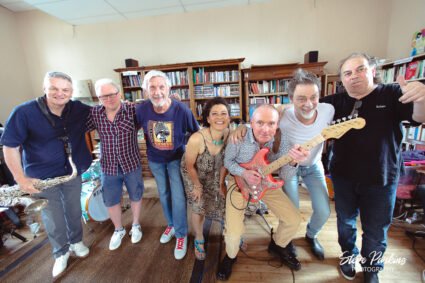
Norrie ‘Snakebite’ Burnett turned 90 this year. For those who know him, that’s not just a number — it’s a life fully and joyfully lived. Norrie loves to sing. He loves to get up in front of a band and shout the blues. He doesn’t get to do it as often as he’d like. So back in January, I decided to do something about that.
The idea was simple. Give Norrie a gig. A real one. For him. To celebrate his birthday and to let him do what he loves, in front of people who love him back.
The planning was quiet and mostly invisible, which is how it should be. A venue to find, musicians to book, a poster to design, tickets to sell. La Ruche Café-Epi in Roussines said yes. Then the musicians said yes. Then the tickets sold out. All of them. A 90-year-old blues shouter in a French village schoolroom, and not a seat to be had. That tells you everything you need to know about Norrie and the people who love him.
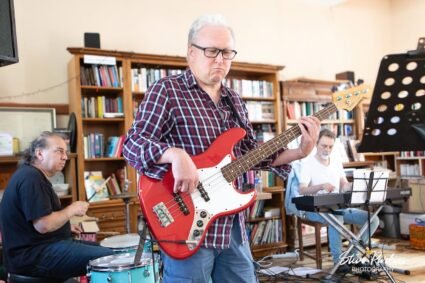
There were no rehearsals. None. The musicians — Bobby Dirninger on keyboards, Aroutian Karapatian on drums, David Donachie on bass, Gordon Menditta on saxophone — turned up on the day and trusted each other. That’s not luck. That’s what good musicians do. Playing with them was, quite simply, like being on holiday.
Madame Blanc opened the show. She set the tone with grace, style and no small amount of fire, and the room was hers from the first note. Then she brought Norrie to the stage.
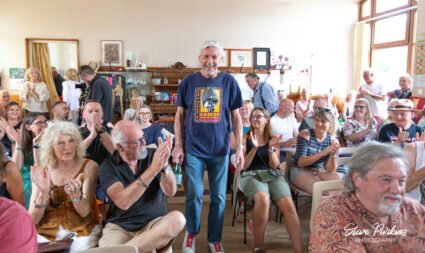
What happened next is difficult to put into words, which is perhaps why Steve Parkins was there with a camera. Norrie took the microphone, raised his arms, and sang. The room responded the way rooms do when something real is happening — they leaned in, they smiled, they forgot about everything else. Robin Spence, who spent five years living in New Orleans, said afterwards that he hadn’t seen better. I’ll take that.
The musicians were exceptional. Every one of them. Bobby Dirninger is Norrie’s favourite keyboard player, and watching the two of them together said everything about why. Aroutian Karapatian held the whole thing together from the drums with a masterful authority that only the finest players possess. David Donachie on bass was exactly what a bass player should be — solid, present, dependable, musical. And Gordon Menditta on saxophone brought colour and warmth to every number he touched.
The audience were magnificent. Their warmth and generosity filled the room as surely as the music did. I watched their faces. The smiles said everything. Those who were there witnessed something genuinely special — the kind of afternoon that doesn’t come around very often, and that stays with you when it does.
Thank you to everyone who came. Thank you to Bobby, Aroutian, David and Gordon. Thank you to Andy Berry and the team at La Ruche for opening the doors and trusting us with the PA. Thank you to Steve Parkins for the photographs — they speak for themselves.
And thank you to Norrie ‘Snakebite’ Burnett. For the music, for the friendship, and for showing us all how it’s done.
There’s a thread on a Strat forum I’ve been part of for more years than I care to count. Every week, someone posts a backing track. The rule — if you can call it that — is simple: you play over it. Whatever it is. Whatever style. Whatever key centre it seems to inhabit. You don’t wait until it suits you. You just play.
I’ve been doing this for a long time now. Long enough that if I tried to calculate the number of tracks, the number of takes, the number of moments where I had absolutely no idea what I was doing, the number would be embarrassing in the best possible way.
And somewhere in all of that, I stumbled onto something I’ve been trying to articulate ever since.
We talk a lot about intention in music. The idea that you should know what you’re going to play before you play it — that great soloists have a plan, a narrative, a destination in mind when they open their mouth or press a string. There’s truth in that. Intention matters. Aimless noodling is its own kind of noise.
But intention has a shadow side. When I am too intentional — when I arrive at a backing track already knowing what I want to say — something closes down. I stop listening. I stop responding. I execute rather than explore. The music becomes a delivery mechanism for an idea I already had, rather than a conversation with something alive.
The weekly discipline taught me something about this. Because you can’t always be prepared. Some weeks the track is a slow blues and you feel settled. Other weeks it’s some lurching odd-time thing and you don’t know where the one is. And in those moments of genuine disorientation, something interesting happens: you have to find something rather than retrieve it.
That’s where accident comes in.
I don’t mean accident in the sense of mistake, though mistakes have their role. I mean the small collision between what you intended and what actually emerged — the note that wasn’t the note you aimed for, but turned out to be better. The phrase that surprised you as you played it. The moment where your fingers went somewhere your conscious mind hadn’t sanctioned, and it worked.
Those moments don’t come from nowhere. They come from years of practice, absorbed and half-forgotten, bubbling up without permission. But they also require a particular quality of openness — a willingness to not clamp down on the unexpected when it arrives.
The weekly forum discipline created exactly that condition. The pressure to produce something — anything — week after week stripped away the luxury of overthinking. You couldn’t afford to wait for inspiration. You had to show up, press record, and deal with whatever happened.
And what happened, often enough, was something better than what I’d planned.
I think about entrances a lot. How you begin a solo over a moving backing track is one of the most revealing things about a player. Do you wait for a landing point — the top of the form, a predictable resolution — before committing? Or do you enter mid-stream, trusting yourself to find the thread?
The players I most admire — and I’m thinking of people like Bill Frisell, who seems to exist in a state of perpetual gentle accident — don’t appear to need a clean runway. They arrive. They’re already in the middle of a thought when you hear them. The music was already happening before they joined it, and somehow they were always already part of it.
That’s not recklessness. It’s a kind of earned surrender — the product of so much intention, so many hours of deliberate practice, that intention itself becomes transparent. You stop being aware of it. You just play.
I’m a cyclist as well as a guitarist, and I’ve noticed the same dynamic on a bike. The races I remember most vividly are not the ones where everything went to plan. They’re the ones where something went wrong and I found a response I didn’t know I had. A gap appeared, or the pace lifted at the wrong moment, or the weather turned, and instead of consulting a plan I simply acted. And sometimes — not always, but sometimes — what I did was exactly right.
You can’t manufacture those moments. But you can create conditions in which they’re more likely to happen: consistent practice, genuine pressure, and the habit of showing up whether you feel ready or not.
The weekly forum thread is that, for me, on guitar. A small, low-stakes arena that has, over years, done more for my playing than almost anything else I can think of.
I said earlier that I’ve been trying to articulate this for a long time. The title I’ve landed on — Between Intention and Accident — feels like the right address for the idea. Not intention. Not accident. The territory between them, which is where, I think, most of the interesting music actually lives.
If you have a discipline like this in your own practice — something you return to week after week, not because it’s always comfortable but precisely because it isn’t — I’d be curious to know. And if you don’t, perhaps it’s worth finding one.
The backing track will be different next week. That’s the whole point.
I was watching a fellow guitarist playing a version of Girl from Ipanema this week — a tune we’ve all been working on together this month. He’s a capable player, but he always reaches for the complicated solution. Things that are beyond him, played with obvious effort, the joins showing. I found myself wondering why. Why make it harder than it needs to be?
It struck me that we are complete opposites.
My instinct, increasingly, is to simplify. To find the least amount that still does the job. Two notes instead of five. A silence held a beat longer than it should be. A chord left to ring until it starts to tell a different story.
That instinct didn’t arrive fully formed. There was a specific moment.
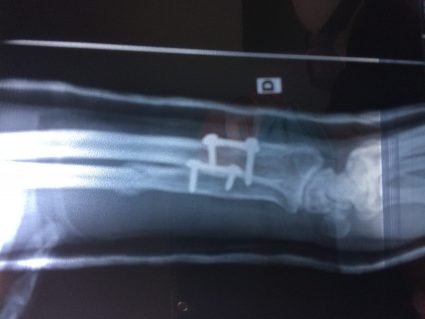
A couple of seasons ago I broke my right arm. Badly enough to spend a good stretch in a cast. And because I am who I am, I still picked up the guitar — carefully, awkwardly, with considerably less available to me than usual. You can’t attack anything with a broken arm in a cast. You can barely hang on.
So I didn’t attack. I played what I could reach. Slowly, with gaps. And somewhere in that enforced restraint I found something I hadn’t expected to find: I liked it. Not just in a “making the best of it” way. Genuinely liked it. I liked the idea of letting something be there slightly longer than it should. A note. A silence. A chord sitting in time and space until it either resolved naturally or started to drift outside of its original intention — starting to clash, starting to become something else. That tension between the thing you placed and the moment it begins to turn. There’s music in that gap.
The broken arm didn’t teach me technique. It taught me patience. It taught me that the guitar doesn’t need you to fill every available moment with something. Sometimes the most interesting thing you can do is put something down and then leave it there, and see what happens. I think about the player I was watching. The complexity is its own kind of effort — a constant forward motion, always reaching for the next thing. There’s nowhere to stop. But stopping is where a lot of the feeling lives.
The cast came off. The arm healed. But I kept the lesson.
Less isn’t a compromise. It’s a choice. And sometimes it’s the harder one — because there’s nowhere to hide in a two-note voicing, a long silence, or a chord that you’re willing to let become something unexpected.
There’s a quote I came across recently that stopped me in my tracks.
“The only way you will get to play beautiful jazz lines is to practice beautiful jazz lines.”
My first instinct was to agree. Then I started thinking about what it actually means — and that’s where it got interesting. Because if you take it literally, it sounds like imitation. Copy beautiful lines until they become yours. And there’s some truth in that. We all learn by absorbing what we love. But what if it means something else entirely? What if “practising beautiful jazz lines” means developing the capacity to create them — not copying, but reaching? Not imitation but intention.
That one shift changes everything. Almost every guitarist starts in the same place. First position. Open chords. The crowded, awkward end of the neck where beginners wrestle with finger pressure, string buzz, and chord shapes that bear little relationship to anything melodic. There’s a logic to it. It produces recognisable results quickly. Three chords and you’re playing songs. The family is impressed. Progress feels visible.
But underneath that logic is an assumption that goes largely unquestioned — that expression comes later. That you have to earn the right to be musical. Technique first, feeling second. Build the foundations, then somewhere up the road, if you work hard enough, the music will follow.
It’s a pyramid. And you start at the bottom.
Most teaching methods, most beginner books, most YouTube tutorials are built on this model. It’s so deeply embedded that it feels like common sense. Like there couldn’t possibly be another way.
But there is.
What if we’ve been doing it the wrong way round? Not wrong in the sense that nobody learns anything. Clearly people do. But wrong in the sense that the pyramid model quietly teaches something unintended — that musicality is a destination rather than a starting point. That creativity is a reward for technical diligence rather than the engine of it.
There’s a different position. A radical one.
Foster creativity from the outset. Not after the foundations are laid. Not when the student is ready. Now. From the very first note.
This doesn’t mean abandoning technique. The mechanics still matter — they always will. But it means keeping the expressive intent visible at every stage of the journey, rather than deferring it to some future point that may never arrive.
Think about what that means in practice. A beginner reaching for something that feels musical — however clumsily, however imperfectly — is doing something more valuable than an advanced player drilling patterns without feeling. The reach itself is the practice.
You don’t accidentally become creative. You have to practise being creative — and you have to start now, not later.
So where do you start? If not first position, then where?
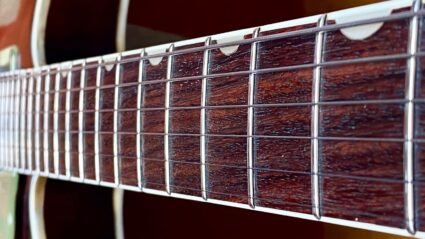
The middle of the neck. Around the fifth to seventh fret. It sounds counterintuitive — isn’t that where you go after you’ve learned the basics? But spend a moment with the idea and it starts to make sense.
Physically, it’s a more comfortable place to be. The hand sits naturally. The stretches are manageable. You’re not fighting the instrument from the first note.
But more importantly — melodically, it’s where the guitar starts to speak. You’re in the voice of the instrument. Single note lines feel natural there. Phrases suggest themselves. You’re not wrestling with open strings and awkward chord shapes — you’re in the middle of the conversation.
And that’s the point. From day one, you’re thinking melodically. You’re reaching for phrases, for shape, for something that sounds like music. Not chord shapes to be memorised. Not patterns to be drilled. Music.
The creativity isn’t deferred. It starts here. Right in the middle.
But here’s where it gets really interesting.
I’ve been thinking about this as a beginner concept. A different starting point. But the more I sit with it, the more I think the real question isn’t about beginners at all.
It’s about the player who learned conventionally, worked hard, made progress — and then somewhere along the way, got stuck. Not stuck in an obvious way. They can play. They know their chords, their scales, their positions. But something is missing and they can’t quite name it.
They search for more complexity. More techniques. More things to learn. But the feeling doesn’t change. Because the problem isn’t what they know. It’s how they’re relating to what they know.
They were taught to build the pyramid. And they built it. But nobody told them what the pyramid was for.
For that player, the middle of the neck isn’t a starting point. It’s a way back in. A way of stripping away the accumulated habit of thinking technically, and rediscovering something that should have been there from the beginning.
The creativity that was deferred. And never quite arrived.
I should be honest. This is a theory, not a proven method. I haven’t taken a complete beginner and started them in the middle of the neck. I haven’t run the experiment.
To do it properly I’d need the right subject. Someone with enough faith in an unorthodox process to resist the pull of conventional milestones. No Knockin’ on Heaven’s Door after three weeks. No grade exams. Just the slow, patient business of learning to reach for something musical from the very first note.
That subject hasn’t appeared yet.
But the question feels important enough to ask out loud. Because if the pyramid model quietly teaches players that creativity is a destination rather than a starting point — and I believe it does — then we’re producing a lot of technically capable guitarists who don’t know what the guitar is for.
And that feels like a waste.
So I’m leaving this here as an open question. Not a conclusion. If any of this resonates — if you recognise yourself somewhere in these pages, whether as the stuck intermediate or the teacher who suspects there might be another way — I’d genuinely like to hear from you.
There’s a particular feeling that jazz gives you, unlike any other music I know. The deeper you go, the more there is. You learn something, truly learn it, and instead of the horizon getting closer it recedes further into the distance. It can feel vertiginous at times. Overwhelming even. And yet you always want to keep going.
This is not a bug. It’s the whole point.
But here’s where a lot of people come unstuck. There’s a common assumption — especially among self-taught musicians — that learning to play is a destination. You put in the hours, you acquire the skills, and at some point you can play. Ticket punched. Job done. What nobody tells you is that the ticket has no destination printed on it.
This is precisely where a tutor, a mentor, a musical confidant becomes not just useful but essential. And I’d argue that’s true at every level — beginner or fifty years in.
A good tutor doesn’t just correct your technique or hand you new material to learn. They see you clearly. They spot the comfortable habits you’ve stopped noticing, the safe ground you keep returning to without realising it. They know where you are in the journey, and they know how to nudge you somewhere new. Sometimes that nudge is a single idea that opens up a whole new stretch of horizon.
The ego is the enemy here of course. The further along you are, the easier it is to feel you’ve earned the right to go it alone. But I’d argue the opposite: the more you know, the more you need someone who can see past what you know. Someone who can say — keep going, you haven’t run out of road yet.
Jazz is an oral tradition. It was never meant to be learned alone. It was passed from player to player, on bandstands and in back rooms, through relationships as much as through music. A tutor keeps that spirit alive, whatever your level, whatever your age.
The horizon keeps moving. That’s the gift. Find someone who helps you walk towards it.
And here’s the thing nobody mentions when you start out: the journey will teach you far more than just music. Patience, humility, the courage to sound bad before you sound good, the ability to sit with uncertainty and keep going anyway. Jazz in particular has a way of holding a mirror up to who you are. How you handle frustration. How you respond to surprise. Whether you can let go of what you know in order to find something better.
A life spent with music, and with the right guide alongside you, is a life spent learning how to be more fully human. That’s not a bad return on a few hours of practice.