
Between Intention and Accident

There’s a thread on a Strat forum I’ve been part of for more years than I care to count. Every week, someone posts a backing track. The rule — if you can call it that — is simple: you play over it. Whatever it is. Whatever style. Whatever key centre it seems to inhabit. You don’t wait until it suits you. You just play.

I’ve been doing this for a long time now. Long enough that if I tried to calculate the number of tracks, the number of takes, the number of moments where I had absolutely no idea what I was doing, the number would be embarrassing in the best possible way.

And somewhere in all of that, I stumbled onto something I’ve been trying to articulate ever since.

We talk a lot about intention in music. The idea that you should know what you’re going to play before you play it — that great soloists have a plan, a narrative, a destination in mind when they open their mouth or press a string. There’s truth in that. Intention matters. Aimless noodling is its own kind of noise.

But intention has a shadow side. When I am too intentional — when I arrive at a backing track already knowing what I want to say — something closes down. I stop listening. I stop responding. I execute rather than explore. The music becomes a delivery mechanism for an idea I already had, rather than a conversation with something alive.

The weekly discipline taught me something about this. Because you can’t always be prepared. Some weeks the track is a slow blues and you feel settled. Other weeks it’s some lurching odd-time thing and you don’t know where the one is. And in those moments of genuine disorientation, something interesting happens: you have to find something rather than retrieve it.

That’s where accident comes in.

I don’t mean accident in the sense of mistake, though mistakes have their role. I mean the small collision between what you intended and what actually emerged — the note that wasn’t the note you aimed for, but turned out to be better. The phrase that surprised you as you played it. The moment where your fingers went somewhere your conscious mind hadn’t sanctioned, and it worked.

Those moments don’t come from nowhere. They come from years of practice, absorbed and half-forgotten, bubbling up without permission. But they also require a particular quality of openness — a willingness to not clamp down on the unexpected when it arrives.

The weekly forum discipline created exactly that condition. The pressure to produce something — anything — week after week stripped away the luxury of overthinking. You couldn’t afford to wait for inspiration. You had to show up, press record, and deal with whatever happened.

And what happened, often enough, was something better than what I’d planned.

I think about entrances a lot. How you begin a solo over a moving backing track is one of the most revealing things about a player. Do you wait for a landing point — the top of the form, a predictable resolution — before committing? Or do you enter mid-stream, trusting yourself to find the thread?

The players I most admire — and I’m thinking of people like Bill Frisell, who seems to exist in a state of perpetual gentle accident — don’t appear to need a clean runway. They arrive. They’re already in the middle of a thought when you hear them. The music was already happening before they joined it, and somehow they were always already part of it.

That’s not recklessness. It’s a kind of earned surrender — the product of so much intention, so many hours of deliberate practice, that intention itself becomes transparent. You stop being aware of it. You just play.

I’m a cyclist as well as a guitarist, and I’ve noticed the same dynamic on a bike. The races I remember most vividly are not the ones where everything went to plan. They’re the ones where something went wrong and I found a response I didn’t know I had. A gap appeared, or the pace lifted at the wrong moment, or the weather turned, and instead of consulting a plan I simply acted. And sometimes — not always, but sometimes — what I did was exactly right.

You can’t manufacture those moments. But you can create conditions in which they’re more likely to happen: consistent practice, genuine pressure, and the habit of showing up whether you feel ready or not.

The weekly forum thread is that, for me, on guitar. A small, low-stakes arena that has, over years, done more for my playing than almost anything else I can think of.

I said earlier that I’ve been trying to articulate this for a long time. The title I’ve landed on — Between Intention and Accident — feels like the right address for the idea. Not intention. Not accident. The territory between them, which is where, I think, most of the interesting music actually lives.

If you have a discipline like this in your own practice — something you return to week after week, not because it’s always comfortable but precisely because it isn’t — I’d be curious to know. And if you don’t, perhaps it’s worth finding one.

The backing track will be different next week. That’s the whole point.
The Gift of the Broken Arm

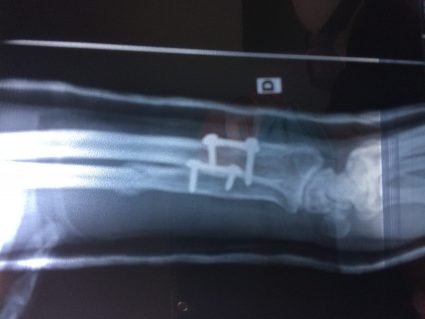
The gift of a broken arm. Right forearm X-ray

I was watching a fellow guitarist playing a version of Girl from Ipanema this week — a tune we’ve all been working on together this month. He’s a capable player, but he always reaches for the complicated solution. Things that are beyond him, played with obvious effort, the joins showing. I found myself wondering why. Why make it harder than it needs to be?

It struck me that we are complete opposites.

My instinct, increasingly, is to simplify. To find the least amount that still does the job. Two notes instead of five. A silence held a beat longer than it should be. A chord left to ring until it starts to tell a different story.

That instinct didn’t arrive fully formed. There was a specific moment.

A couple of seasons ago I broke my right arm. Badly enough to spend a good stretch in a cast. And because I am who I am, I still picked up the guitar — carefully, awkwardly, with considerably less available to me than usual. You can’t attack anything with a broken arm in a cast. You can barely hang on.

So I didn’t attack. I played what I could reach. Slowly, with gaps. And somewhere in that enforced restraint I found something I hadn’t expected to find: I liked it. Not just in a “making the best of it” way. Genuinely liked it. I liked the idea of letting something be there slightly longer than it should. A note. A silence. A chord sitting in time and space until it either resolved naturally or started to drift outside of its original intention — starting to clash, starting to become something else. That tension between the thing you placed and the moment it begins to turn. There’s music in that gap.

The broken arm didn’t teach me technique. It taught me patience. It taught me that the guitar doesn’t need you to fill every available moment with something. Sometimes the most interesting thing you can do is put something down and then leave it there, and see what happens. I think about the player I was watching. The complexity is its own kind of effort — a constant forward motion, always reaching for the next thing. There’s nowhere to stop. But stopping is where a lot of the feeling lives.

The cast came off. The arm healed. But I kept the lesson.

Less isn’t a compromise. It’s a choice. And sometimes it’s the harder one — because there’s nowhere to hide in a two-note voicing, a long silence, or a chord that you’re willing to let become something unexpected.

All you can do is put it there. And trust it.

Starting in the Middle

Gretsch Country Gentleman 1967

There’s a quote I came across recently that stopped me in my tracks.

“The only way you will get to play beautiful jazz lines is to practice beautiful jazz lines.”

My first instinct was to agree. Then I started thinking about what it actually means — and that’s where it got interesting. Because if you take it literally, it sounds like imitation. Copy beautiful lines until they become yours. And there’s some truth in that. We all learn by absorbing what we love. But what if it means something else entirely? What if “practising beautiful jazz lines” means developing the capacity to create them — not copying, but reaching? Not imitation but intention.

That one shift changes everything.
Almost every guitarist starts in the same place. First position. Open chords. The crowded, awkward end of the neck where beginners wrestle with finger pressure, string buzz, and chord shapes that bear little relationship to anything melodic. There’s a logic to it. It produces recognisable results quickly. Three chords and you’re playing songs. The family is impressed. Progress feels visible.

But underneath that logic is an assumption that goes largely unquestioned — that expression comes later. That you have to earn the right to be musical. Technique first, feeling second. Build the foundations, then somewhere up the road, if you work hard enough, the music will follow.

It’s a pyramid. And you start at the bottom.

Most teaching methods, most beginner books, most YouTube tutorials are built on this model. It’s so deeply embedded that it feels like common sense. Like there couldn’t possibly be another way.

But there is.

What if we’ve been doing it the wrong way round?
Not wrong in the sense that nobody learns anything. Clearly people do. But wrong in the sense that the pyramid model quietly teaches something unintended — that musicality is a destination rather than a starting point. That creativity is a reward for technical diligence rather than the engine of it.

There’s a different position. A radical one.

Foster creativity from the outset. Not after the foundations are laid. Not when the student is ready. Now. From the very first note.

This doesn’t mean abandoning technique. The mechanics still matter — they always will. But it means keeping the expressive intent visible at every stage of the journey, rather than deferring it to some future point that may never arrive.

Think about what that means in practice. A beginner reaching for something that feels musical — however clumsily, however imperfectly — is doing something more valuable than an advanced player drilling patterns without feeling. The reach itself is the practice.

You don’t accidentally become creative. You have to practise being creative — and you have to start now, not later.

So where do you start? If not first position, then where?

The middle of the neck.
Around the fifth to seventh fret. It sounds counterintuitive — isn’t that where you go after you’ve learned the basics? But spend a moment with the idea and it starts to make sense.

Physically, it’s a more comfortable place to be. The hand sits naturally. The stretches are manageable. You’re not fighting the instrument from the first note.

But more importantly — melodically, it’s where the guitar starts to speak. You’re in the voice of the instrument. Single note lines feel natural there. Phrases suggest themselves. You’re not wrestling with open strings and awkward chord shapes — you’re in the middle of the conversation.

And that’s the point. From day one, you’re thinking melodically. You’re reaching for phrases, for shape, for something that sounds like music. Not chord shapes to be memorised. Not patterns to be drilled. Music.

The creativity isn’t deferred. It starts here. Right in the middle.

But here’s where it gets really interesting.

I’ve been thinking about this as a beginner concept. A different starting point. But the more I sit with it, the more I think the real question isn’t about beginners at all.

It’s about the player who learned conventionally, worked hard, made progress — and then somewhere along the way, got stuck. Not stuck in an obvious way. They can play. They know their chords, their scales, their positions. But something is missing and they can’t quite name it.

They search for more complexity. More techniques. More things to learn. But the feeling doesn’t change. Because the problem isn’t what they know. It’s how they’re relating to what they know.

They were taught to build the pyramid. And they built it. But nobody told them what the pyramid was for.

For that player, the middle of the neck isn’t a starting point. It’s a way back in. A way of stripping away the accumulated habit of thinking technically, and rediscovering something that should have been there from the beginning.

The creativity that was deferred. And never quite arrived.

I should be honest. This is a theory, not a proven method. I haven’t taken a complete beginner and started them in the middle of the neck. I haven’t run the experiment.

To do it properly I’d need the right subject. Someone with enough faith in an unorthodox process to resist the pull of conventional milestones. No Knockin’ on Heaven’s Door after three weeks. No grade exams. Just the slow, patient business of learning to reach for something musical from the very first note.

That subject hasn’t appeared yet.

But the question feels important enough to ask out loud. Because if the pyramid model quietly teaches players that creativity is a destination rather than a starting point — and I believe it does — then we’re producing a lot of technically capable guitarists who don’t know what the guitar is for.

And that feels like a waste.

So I’m leaving this here as an open question. Not a conclusion. If any of this resonates — if you recognise yourself somewhere in these pages, whether as the stuck intermediate or the teacher who suspects there might be another way — I’d genuinely like to hear from you.

Maybe that’s how the experiment begins.