There’s a particular feeling that jazz gives you, unlike any other music I know. The deeper you go, the more there is. You learn something, truly learn it, and instead of the horizon getting closer it recedes further into the distance. It can feel vertiginous at times. Overwhelming even. And yet you always want to keep going.
This is not a bug. It’s the whole point.
But here’s where a lot of people come unstuck. There’s a common assumption — especially among self-taught musicians — that learning to play is a destination. You put in the hours, you acquire the skills, and at some point you can play. Ticket punched. Job done. What nobody tells you is that the ticket has no destination printed on it.
This is precisely where a tutor, a mentor, a musical confidant becomes not just useful but essential. And I’d argue that’s true at every level — beginner or fifty years in.
A good tutor doesn’t just correct your technique or hand you new material to learn. They see you clearly. They spot the comfortable habits you’ve stopped noticing, the safe ground you keep returning to without realising it. They know where you are in the journey, and they know how to nudge you somewhere new. Sometimes that nudge is a single idea that opens up a whole new stretch of horizon.
The ego is the enemy here of course. The further along you are, the easier it is to feel you’ve earned the right to go it alone. But I’d argue the opposite: the more you know, the more you need someone who can see past what you know. Someone who can say — keep going, you haven’t run out of road yet.
Jazz is an oral tradition. It was never meant to be learned alone. It was passed from player to player, on bandstands and in back rooms, through relationships as much as through music. A tutor keeps that spirit alive, whatever your level, whatever your age.
The horizon keeps moving. That’s the gift. Find someone who helps you walk towards it.
And here’s the thing nobody mentions when you start out: the journey will teach you far more than just music. Patience, humility, the courage to sound bad before you sound good, the ability to sit with uncertainty and keep going anyway. Jazz in particular has a way of holding a mirror up to who you are. How you handle frustration. How you respond to surprise. Whether you can let go of what you know in order to find something better.
A life spent with music, and with the right guide alongside you, is a life spent learning how to be more fully human. That’s not a bad return on a few hours of practice.
On jazz, bicycles, and the art of mischievous friction
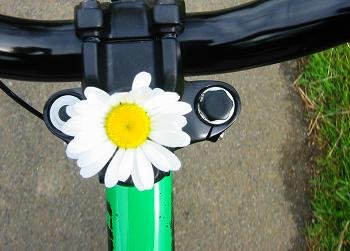
There is a particular quality of thinking that happens on a long bicycle ride through a forest. The rhythm of the pedalling, the canopy overhead, the absence of interruption — it creates a space where ideas can unspool at their own pace. Last week, riding through the forest of Rochechouart, I found myself turning over a question I have been turning over for years without ever quite stopping to examine it directly. What actually is improvisation? And could it be considered spontaneous composition?
aimlessly drifting along…
The Case for Spontaneous Composition
The framing holds up reasonably well on first inspection. When you improvise, you are making all the same fundamental decisions a composer makes — melodic shape, rhythm, harmonic choice, tension and release, silence. The difference is the timescale. A composer can revise; an improviser commits in real time. But the act of musical decision-making is structurally identical. There is also the question of what improvisation actually draws on. Nobody improvises from nothing. You draw on internalised vocabulary, patterns, emotional states, the harmonic landscape under you, what the other musicians just played. In a sense, the composition happened over years of practice. The spontaneous moment is more like retrieval and recombination than pure creation from nothing — though that is arguably true of written composition too. But the framing gets complicated quickly. Composition usually implies some intention toward a fixed, repeatable object — a piece that exists independently of any one performance. Improvisation is inherently ephemeral and relational. It is shaped by the room, the rhythm section, a moment of hesitation from the bassist. That responsiveness is its most distinctive quality, and the word composition does not quite capture it.
Pre-loading the Stance
Thinking about this on the bike, I arrived at a description of my own practice that felt more honest than either composition or conversation. Sometimes I set out on a tune with an intention. Not a musical intention in the technical sense — not a plan for which scales to use or which substitutions to make. Something more like a dramatic premise. I might think: I am going to clash the hell out of this one. I am going to argue my way through it. That is how I feel today. And then I just play. What I am doing in that moment is pre-loading a stance. I am not pre-composing notes, I am pre-loading an attitude, an energy, a posture. The music then finds its own way through that filter. Two distinct layers operate simultaneously: the intentional layer, which is the mood or the argument I have chosen to bring; and the spontaneous layer, the actual notes and phrases that emerge in real time but have been given a direction to flow in. It is a bit like the difference between deciding how you are going to walk into a room versus the actual steps you take. The character is chosen; the choreography just happens. What strikes me about this is how physical and emotional it is before it is musical. You are not thinking about flattened ninths and rhythmic displacement — you are thinking: I am restless, I want friction. And then years of vocabulary serves that feeling without you having to consciously direct it. At a certain level of musicianship, technique becomes almost transparent. A clear medium through which something pre-verbal gets expressed.
Mischievous Friction
I would say — I do not always want to win the argument. Sometimes I just want to create some mischievous friction. That is actually a more interesting goal than winning, because winning implies a conclusion, a resolution. Friction that is genuinely mischievous stays alive. It does not resolve; it keeps the listener slightly off-balance, slightly unsure whether what just happened was intentional or whether you are about to fall over. That ambiguity is the point. For this to work, though, you need the right response from around you. If you are there trying to start a musical argument and the band is all peace and love, you are done. That is where the card up the sleeve comes in — the back-pocket contingency. Not just one pre-loaded attitude but a small repertoire of them. If the argument is not landing, you shift. Instead of clashing head-on, you go quiet and sardonic. You let the peace-and-love wash over you and then drop something slightly unsettling underneath it. Some tunes hand you more cards than others. Donna Lee, for example — lots of cards, but it is a tight fit shirt. The changes move so fast and so purposefully that there is not much room to lounge around in. And yet that constraint might actually serve the mischief rather than prevent it. When everything around you is that disciplined, even a small deviation stands out sharply. The tightness of the shirt makes every wrinkle visible. The tune becomes your straight man.
The Cyclist in the First Five Minutes
The best co-conspirators for this kind of playing share certain qualities. They have to be at ease and comfortable — because if someone is anxious about their own playing, all their attention is turned inward. They are managing themselves, not listening outward. There is no spare bandwidth for catching a wink across the room. They have to be confident — and this is separate from ability, which is an important distinction. A highly able player who is insecure can be the most rigid of all. They have the most to protect. Whereas someone with less technical firepower but a settled sense of who they are musically can afford to take risks, to go somewhere unexpected, because they are not worried about being exposed. And they have to be listeners. Because mischief in music is essentially a signal sent to another person. If they are not listening with that particular alert, open quality, the signal just goes into the air and disappears. The remarkable thing is that you can often spot all of this before a note is played. Just in how they set up, how they handle their instrument when nobody is officially listening yet. Whether they noodle with genuine curiosity or just run scales to fill the silence. Whether their eyes are open or closed to what is around them. It is exactly like going for a bicycle ride with someone new. You can tell within the first few minutes whether they know how to ride or not. Not from how fast they go or how fit they look — something in how they sit on the bike, how they handle the first corner, whether they are fighting the machine or simply in it. What you are reading in both cases is the same thing: confident familiarity. A relationship with something they have absorbed deeply over years. At a certain point it stops being a skill you perform and becomes a way you inhabit something. And the people who have it share one defining quality — they have no need to prove it. The moment you are proving something, you have introduced an audience into your head. You are no longer just doing the thing; you are watching yourself do it and managing how it looks. That internal observer is deadly to real presence.
Back Where We Started
I rode back into the village having gone around the question without quite answering it — which feels about right. The best loops do that. You arrive back at the start and it looks the same, but you are not quite the same for having gone round it. Improvisation is not spontaneous composition, not exactly. It is something more relational, more alive than that — shaped by the room, the other players, the particular quality of attention in the moment. But at its best, when the stance is pre-loaded and the right co-conspirators are in the room and the tune is handing out cards, it achieves something that written composition works very hard to simulate. It sounds like someone who has no need to prove anything at all.
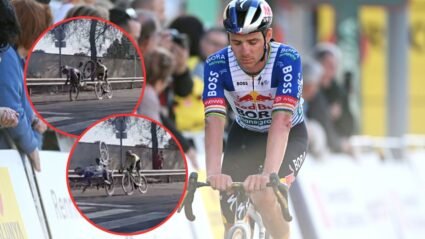
By now, you’ve seen the clip. Stage 3 of the 2026 Volta a Catalunya. Remco Evenepoel and Jonas Vingegaard, alone inside the final kilometer. Remco enters a roundabout, hits a pothole, shifts his hand position — and goes over the bars.
The cycling world moved on quickly. Pothole. Bad luck. Remco blamed his hand position. Jonas showed sportsmanship by waiting. End of story.
But I’ve watched the slow-motion replay dozens of times. And something doesn’t add up.
Remco’s rear wheel lifts clean off the ground — the unmistakable signature of a front brake fully locked. A pothole can knock your hands loose. A pothole cannot squeeze your brake lever.
So what did?
What Everyone Saw
The official explanation is straightforward: Remco was moving his hands to the drops when he hit an unmarked pothole. The impact jarred his grip, he lost control, and he crashed.
That’s true as far as it goes. But it’s incomplete.
Watch the replay carefully. His bike doesn’t just wobble. The rear wheel rises like he’s hit an invisible wall. That’s not a steering correction gone wrong. That’s a front brake engaged at maximum force — at 50+ km/h, mid-corner, with no time to react.
The Missing Question
Here’s what no interviewer asked and no commentator raised:
Why did a pothole lead to a full front brake lockup?
The assumption seems to be that Remco simply grabbed a handful of brake by accident. But Remco Evenepoel is not a novice. He has thousands of race hours and some of the finest bike-handling skills in the peloton. He doesn’t “accidentally” grab fistfuls of front brake.
Something else happened. And I believe it comes down to a recent, overlooked change: his groupset.
The Switch No One Is Talking About
When Remco moved to Red Bull-Bora-Hansgrohe for 2026, he changed more than his jersey. He switched from Shimano Dura-Ace Di2 — his groupset for years at Quick-Step and Soudal — to SRAM Red AXS.
On paper, both are world-class. But on the road, they feel fundamentally different.
Feature
Shimano Dura-Ace Di2
SRAM Red AXS
Lever feel
Heavier, progressive
Feather-light, immediate
Initial bite
Aggressive (“grabby”)
Linear, builds with pressure
Force to max braking
High
Low
Modulation
Good
Excellent
Neither is “better.” But they are not interchangeable. And your hands know the difference — even if your conscious brain doesn’t.
The Muscle Memory Trap
Here’s the critical point that everyone has missed:
After years on Shimano, Remco’s braking reflex is calibrated to a specific force curve. When his brain says “hard brake now,” his hands automatically apply the amount of lever pressure that would produce maximum stopping power on a Shimano system.
But SRAM doesn’t need that much pressure. SRAM achieves full braking with significantly less lever force.
So what happens when a Shimano-trained rider grabs SRAM brakes at race speed?
The Two-Stage Over-Brake
I believe the crash unfolded in two stages — too fast for the naked eye, but visible in the physics of the bike:
Stage 1 — The Shimano Grab Remco hits the pothole, his hands shift, and instinct takes over. He pulls the lever with the force that would deliver aggressive Shimano bite. But SRAM’s initial feel is lighter. His brain registers: “Not enough braking.”
Stage 2 — The SRAM Overcorrection He squeezes harder — exactly as Shimano would require. But SRAM’s lever is designed for light action. That second-stage squeeze translates not into proportional braking, but into instant full lockup. The front wheel stops. The rear wheel lifts. The crash becomes inevitable.
This wasn’t one mistaken grab. It was a feedback loop — a mismatch between years of learned pressure and a new lever’s response curve.
Why No One Is Talking About This
If this analysis is correct, why has it been absent from every recap, interview, and comment section?
Sponsor pressure. No journalist wants to ask: “Did SRAM’s brake feel contribute to your crash?” That’s a career-limiting question.
Rider pride. Remco said, “I shifted my hand position, hit a pothole, lost control.” He’s not going to say, “The brakes responded differently than my body expected.” That sounds like an excuse, and pros don’t make excuses.
Technical illiteracy. Most fans and many reporters don’t think about force curves, bite points, or neuromuscular adaptation. They see a crash and look for a single visible cause. The pothole is right there. Case closed.
What This Means for Pro Cycling
If I’m right, this crash wasn’t bad luck or rider error. It was a predictable consequence of switching groupsets without retraining the rider’s braking reflex.
Teams spend hours on bike fits, power meters, and aerodynamic positioning. But how much time is dedicated to recalibrating a rider’s hands to a new lever feel?
We need:
Brake-force simulation drills during preseason for riders switching component sponsors
Lever tuning — adjusting reach, contact point, and modulation to approximate familiar feel
Pressure mapping to quantify the mismatch between a rider’s ingrained force and a new system’s response
Conclusion
Remco Evenepoel’s crash at Catalunya was not a simple accident. It was a collision between human instinct and machine design — a Shimano-trained hand grabbing a SRAM brake at 50 km/h, with a pothole as the trigger and physics as the judge.
The cycling world saw the pothole and moved on.
But watch the replay again. Watch the rear wheel lift. And ask yourself: What really stopped that bike?
I think AI is having a genuinely good effect on jazz music!
There’s a lot of anxiety around AI in music at the moment, and jazz is no exception. In fact, if anything, the reaction from jazz musicians tends to be particularly negative.
I understand why. Jazz is deeply human music. It’s about interaction, identity, listening, and presence in the moment. The idea of something artificial stepping into that space feels, at best, uncomfortable.
But I think it helps to separate two very different ideas: AI as a performer, and AI as a tool.
As a tool, I believe AI is already having a genuinely positive effect on jazz—and on how we learn it.
In a previous article, I wrote about using AI for stem separation, and how useful that can be for practising musicians. Being able to take a recording and isolate exactly what a pianist is doing with their left hand, or hear clearly what the bassist is playing under a busy head, simply wasn’t possible before. If you want to play along with some of the greatest musicians who ever lived, properly isolated, it’s an extraordinary resource.
I’ve been experimenting further with this approach recently while working on Little Sunflower. For this piece, I used AI tools to remove the drums and reduce some of the density in the original recording, leaving a much more open space to play in.
What struck me immediately was how clearly the time feel came through. With less going on, you can really hear how “in the pocket” the playing is—and that changes how you respond to it. It’s not something you necessarily notice in a full mix, but once it’s exposed, it becomes impossible to ignore.
That kind of detail matters. It affects how you phrase, how you place notes, and how you listen.
Transcription is another area that has changed. The mechanical side of getting notes down is faster now, which means more time can be spent on what really matters—interpretation, phrasing, feel, and making the music your own.
Then there are AI accompaniment tools. Not everyone has a drummer and bassist available on demand, but time feel and interaction are at the heart of jazz. Being able to work on these things in a meaningful way, even when practising alone, is a real advantage.
Audio restoration is also worth mentioning. Older recordings, sometimes degraded or unclear, can now be brought back with a level of clarity that reveals details which were previously hidden. That’s not just a technical improvement—it’s a way of reconnecting with the tradition in a deeper and more direct way.
This is where I think the real value lies. These tools don’t replace the work. They don’t replace listening, or developing a personal voice, or the challenge of playing in real time with other musicians. If anything, they give us better access to the material that helps us grow.
The concern seems to come from imagining AI as a composer or performer—something that generates music in place of people. That’s a different and more complicated conversation, and one that raises valid questions.
But that’s not what I’m talking about here.
Used in the right way, AI isn’t making jazz. It’s helping musicians hear more clearly, understand more deeply, and engage more directly with the music.
And that, to me, is a good thing.
If you’re interested, I’ve written more about the technical side of this in my earlier article on AI stem separation.