
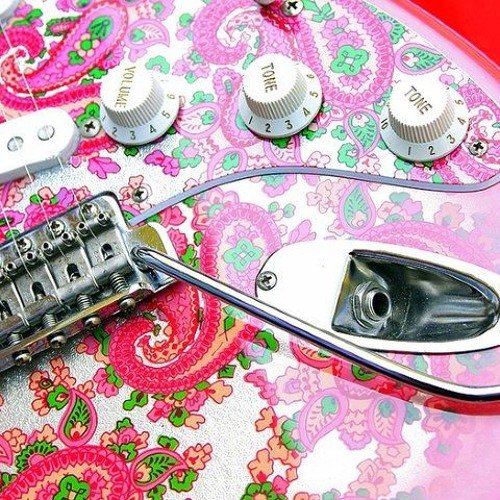
A Stratocaster for Jazz? I was reading a discussion recently about “beefing up” Stratocaster tone. You see this a lot. Suggestions about hotter pickups, thicker sounds, ways to make a Strat behave a little less like a Strat and a little more like something else.
It makes me smile.Because the more I play mine, the more convinced I am that nothing needs beefing up at all.It’s supposed to sound like that. It’s a Strat.
I play a lot of jazz on a Stratocaster. A pink Paisley one, no less. Which probably breaks expectations before a note is even played.
For many people, jazz guitar still carries a very specific image: big hollow body, dark tone, neck pickup, highs rolled off, one carefully controlled sound maintained all evening. And there’s nothing wrong with that sound. It’s beautiful. It’s part of the history. But lately I’ve been wondering whether we sometimes confuse tradition with necessity. Because when you think about what jazz actually is, the Strat starts to make enormous sense.
Jazz, at its heart, is conversation.
It’s listening.
Reacting.
Leaving space.
Changing direction in response to what someone else just played.
When that’s happening, sound can’t stay fixed. It has to move. One of the reasons I disappear for hours when playing my Strat is that it constantly asks for engagement. I’m always on the volume and tone controls, shifting colour, softening attack, swelling chords, brightening or thinning the sound depending on what I hear around me.
From a warm whisper to something close to a scream — all without changing guitars, pedals, or settings. Just touch and attention.
The clarity of a Strat does something important for jazz harmony too.
Chords don’t blur.
Extensions remain audible.
Inner voices speak.
Instead of becoming a block of sound, harmony keeps breathing. It feels closer to a piano than to the traditional idea of jazz guitar thickness. And rhythmically, the immediacy of the attack makes time feel alive. Small differences in touch suddenly matter. Placement matters. Intent becomes audible. The guitar responds instantly — which means you have to listen instantly.
Historically, the darker jazz guitar sound made perfect sense. Early amplification demanded control and blend. Guitars needed to sit safely inside acoustic ensembles. But those practical limitations are gone. What remains is expectation. And expectation can be stubborn.
The longer I play, the less interested I am in making instruments imitate one another.
A Stratocaster doesn’t need to become an archtop. Its strength is responsiveness, transparency, and movement. Tone becomes part of improvisation itself rather than a fixed identity established before the first tune. From an expressive point of view, that might make it one of the most complete jazz instruments available.
So yes — I play jazz on a pink Paisley Strat. Once the music starts, nobody seems to care what the guitar is supposed to look or sound like. They just listen.
Which, when you think about it, is the whole point.