From the Boxes to Somewhere Else

My jazz tutor Matt Warnock recently flipped a familiar saying on its head. It’s not necessity, he suggested, but boredom that is the mother of invention. His challenge was simple: play over the same thing for long enough that you run out of ideas. And then keep going. That’s where the interesting stuff lives.

I took that idea and sat with a minor blues backing track for just over ten minutes. I started where most of us start — inside the familiar pentatonic boxes, playing what I know, reaching for the phrases that have always been there. Safe ground. Comfortable ground.

But I kept going.

Somewhere around the halfway mark the vocabulary started to dry up. The boxes felt smaller. And rather than stopping — which is what I usually do — I pushed through. By the final few minutes I was playing purely by ear, reaching for outside notes, deliberate dissonance, chromaticism. Stuff I’d call “tangy.” Some of it surprised me. Not all of it was pretty. But it was mine in a way that the earlier, safer playing wasn’t.

The minor blues was just the launchpad.

What strikes me about Matt’s idea is that boredom is usually the signal to stop. We run out of steam, we put the guitar down, we make a cup of tea. But boredom might actually be the threshold — the point where the rehearsed vocabulary is exhausted and something more personal can emerge. The magic isn’t despite the boredom. It’s because of it.

You don’t need to be a jazz guitarist for this to apply. Pick anything — a chord progression, a groove, a single scale — and stay with it longer than feels comfortable. Past the point where you think you have nothing left to say. See what’s on the other side.

I’d love to know how far out you’re willing to go before you pull back.
The Case for the Stratocaster as a Jazz Instrument

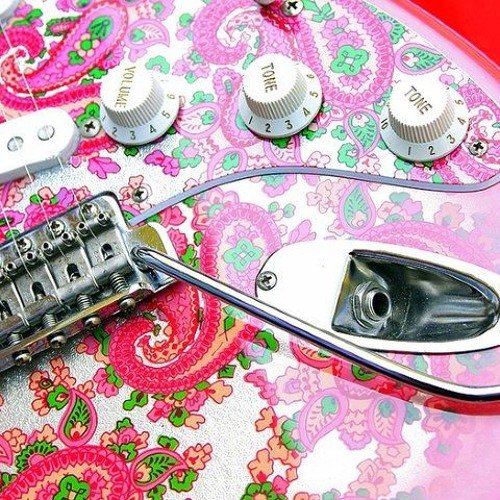
Paisley Strat 2004 CIJ

A Stratocaster for Jazz? I was reading a discussion recently about “beefing up” Stratocaster tone. You see this a lot. Suggestions about hotter pickups, thicker sounds, ways to make a Strat behave a little less like a Strat and a little more like something else.

It makes me smile.Because the more I play mine, the more convinced I am that nothing needs beefing up at all.It’s supposed to sound like that. It’s a Strat.

I play a lot of jazz on a Stratocaster. A pink Paisley one, no less. Which probably breaks expectations before a note is even played.

For many people, jazz guitar still carries a very specific image: big hollow body, dark tone, neck pickup, highs rolled off, one carefully controlled sound maintained all evening. And there’s nothing wrong with that sound. It’s beautiful. It’s part of the history. But lately I’ve been wondering whether we sometimes confuse tradition with necessity. Because when you think about what jazz actually is, the Strat starts to make enormous sense.

Jazz, at its heart, is conversation.
It’s listening.
Reacting.
Leaving space.
Changing direction in response to what someone else just played.

When that’s happening, sound can’t stay fixed. It has to move. One of the reasons I disappear for hours when playing my Strat is that it constantly asks for engagement. I’m always on the volume and tone controls, shifting colour, softening attack, swelling chords, brightening or thinning the sound depending on what I hear around me.

From a warm whisper to something close to a scream — all without changing guitars, pedals, or settings. Just touch and attention.

The clarity of a Strat does something important for jazz harmony too.
Chords don’t blur.
Extensions remain audible.
Inner voices speak.

Instead of becoming a block of sound, harmony keeps breathing. It feels closer to a piano than to the traditional idea of jazz guitar thickness. And rhythmically, the immediacy of the attack makes time feel alive. Small differences in touch suddenly matter. Placement matters. Intent becomes audible. The guitar responds instantly — which means you have to listen instantly.

Historically, the darker jazz guitar sound made perfect sense. Early amplification demanded control and blend. Guitars needed to sit safely inside acoustic ensembles. But those practical limitations are gone. What remains is expectation. And expectation can be stubborn.

The longer I play, the less interested I am in making instruments imitate one another.
A Stratocaster doesn’t need to become an archtop. Its strength is responsiveness, transparency, and movement. Tone becomes part of improvisation itself rather than a fixed identity established before the first tune. From an expressive point of view, that might make it one of the most complete jazz instruments available.

So yes — I play jazz on a pink Paisley Strat. Once the music starts, nobody seems to care what the guitar is supposed to look or sound like. They just listen.

Which, when you think about it, is the whole point.

Little Sunflower by Freddie Hubbard

Little Sunflower by Freddie Hubbard has been my focus this month.

I’ve been part of Matt Warnock’s online jazz study group for a number of years now. Each month we work on a different tune, and at the end of it we submit a performance for feedback—from Matt and from other players in the group. It’s a great process. There are musicians from all over the world involved, and over time you really start to hear how people develop.
February’s tune was Little Sunflower by Freddie Hubbard. I love this tune, and I didn’t just want to play the tune from the lead sheet. I wanted to bring something of my own to it.

Depending on how you look at Little Sunflower, the harmony allows D and A to sit almost like drone tones throughout. That became the starting point. I set up a series of drones with swells and stutters, letting them evolve using delay, reverb and tremolo. The oscillation isn’t locked to the tempo—it moves independently—and I like what that does. It adds a sense of movement underneath everything, without being tied down.

I recorded the drones using my looper with an “empty loop” technique, then shaped them further with effects. In places I drop them out completely, just to let the piece breathe.

Everything was recorded in my little room at the end of the house—my music room. Guitar and bass are both me. The drums were part of a backing track provided by Matt for the month’s study (see my article on AI stem separation for more). I wanted to keep the whole thing fairly minimal, real, and feel like a band performance.

The arrangement grew quite naturally. The intro is made up of short chord punches that hint at the B section before moving into the full head. I play the melody in a few different ways—single line and with different harmonies—as this is something I’m submitting to my peers, so I wanted to explore that side of it a bit more.

After that there’s a solo over the form, with each A section getting a slightly different bass treatment. For the head out, the bass takes the melody. When the B section comes around, it starts in a more familiar way, then shifts—first into two-bar phrases, then into one-bar phrases. At that point it starts to feel less like a melody and more like a bass line, which opens things up for a kind of ride-out solo.

Right at the end, bass and guitar come together on the shortened B section.

I recorded and mixed everything myself. The final step was to do the live guitar take with video—one take, no overthinking—and that’s what you see here, and what I submitted.

I’ve built a bit of a reputation in the group for trying different things—textures, sounds, approaches—and for me that’s where the interest is. Just playing the tune as it sits on the page isn’t enough. I think we have to bring more of ourselves to it, and in my case that includes using technology as part of the process, not as a gimmick but as a way of shaping the music.

After submitting this, Matt shared some really kind words about it, which meant a lot given the level of players in the group and how long I’ve been part of it:

“Serge just posted his Little Sunflower Final Project, and it’s a beautiful example of what steady, patient growth can look like over time.

His playing has taken a big step forward. More atmosphere. More intention. More storytelling in the music.

For this project he didn’t just play the tune. He built an environment around it… It’s creative. Thoughtful. And very musical.

One of the things I love most is how Serge keeps experimenting… That curiosity is where real musical growth happens.”

That idea of steady growth, and staying curious, is really what this is all about. I hope you enjoyed it.