Listen, What Do You Hear?

Earlier this year, Matt Warnock ran a series of live sessions he called a camp. The subject was the art of listening — specifically, the art of listening to jazz. It was a timely reminder that listening is not a passive act. It is something you develop, something you practice, something you can get better at.

I’ve been thinking about that ever since.

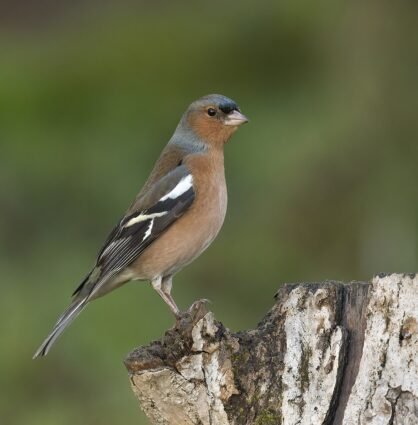
This morning I was working away on guitar in my room. The window was open. A chaffinch was singing in the garden, doing what chaffinches do, completely indifferent to what I was playing. Then for a moment, just a moment, it fitted perfectly. The bird’s phrase landed in a gap I hadn’t even noticed I’d left. It was one of those small, unrepeatable moments that stop you mid-phrase. It was perfect. Couldn’t have been more perfect.
My first instinct was to reach for a recorder. Capture it. Use it somehow.

Then I thought: use it for what, exactly? The moment was already gone. What made it perfect was precisely that it wasn’t arranged. The chaffinch wasn’t listening to me. I wasn’t listening for the chaffinch. We just happened to be in the same space at the same time, and something clicked.

That’s not something you can manufacture.

I’ve been turning this over in relation to how I work more broadly. I don’t catalogue my musical ideas. I don’t file licks under headings for later retrieval. I record a lot, and I drop material from one session into another — not systematically, but instinctively, the way a tape machine used to bleed ghost tracks through from previous sessions if you looked for a clean track on a well-used reel. The surprise encounter is part of the point. You can’t predict where something will fit, and the attempt to control that tends to kill the very quality you were trying to preserve.

Listening, real listening, might work the same way. Not hunting for something specific, but remaining open enough that what’s there can reach you.

The chaffinch didn’t study jazz. It didn’t attend a camp on the art of listening. It simply sang into the available space, without hesitation, without agenda.

I suspect it has something to do with the quality of attention you bring to a moment, rather than what you bring to it technically. Less acquisition, more presence.

The window is still open. The garden is quiet now.

But I’m listening differently than I was this morning.
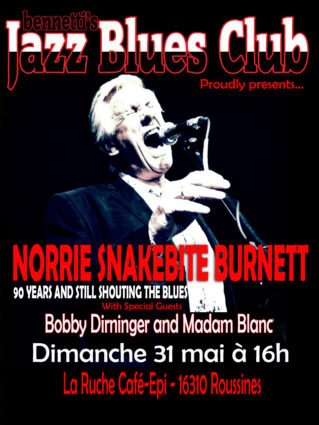
90 Years and Still Shouting the Blues

Norrie Snakebite Burnett - Still shouting the Blues

Norrie ‘Snakebite’ Burnett turned 90 this year. For those who know him, that’s not just a number — it’s a life fully and joyfully lived. Norrie loves to sing. He loves to get up in front of a band and shout the blues. He doesn’t get to do it as often as he’d like. So back in January, I decided to do something about that.

The idea was simple. Give Norrie a gig. A real one. For him. To celebrate his birthday and to let him do what he loves, in front of people who love him back.

The planning was quiet and mostly invisible, which is how it should be. A venue to find, musicians to book, a poster to design, tickets to sell. La Ruche Café-Epi in Roussines said yes. Then the musicians said yes. Then the tickets sold out. All of them. A 90-year-old blues shouter in a French village schoolroom, and not a seat to be had. That tells you everything you need to know about Norrie and the people who love him.

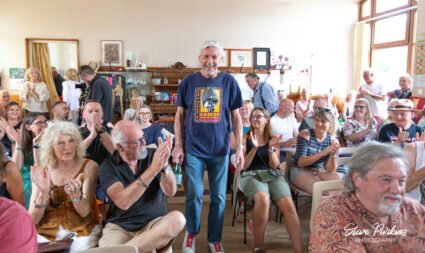
Norrie takes to the stage.

There were no rehearsals. None. The musicians — Bobby Dirninger on keyboards, Aroutian Karapatian on drums, David Donachie on bass, Gordon Menditta on saxophone — turned up on the day and trusted each other. That’s not luck. That’s what good musicians do. Playing with them was, quite simply, like being on holiday.

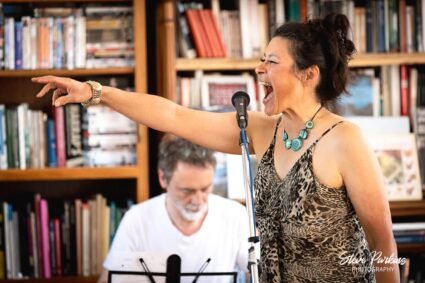
Madame Blanc opened the show. She set the tone with grace, style and no small amount of fire, and the room was hers from the first note. Then she brought Norrie to the stage.

Madame Blanc in full force.

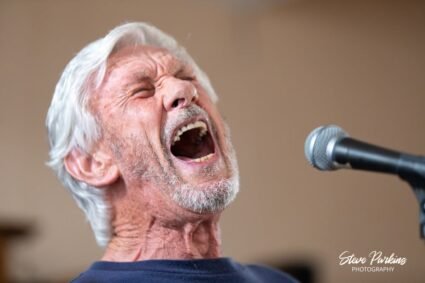
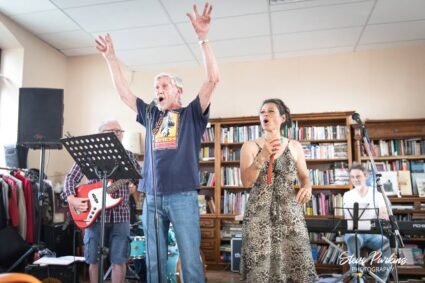
What happened next is difficult to put into words, which is perhaps why Steve Parkins was there with a camera. Norrie took the microphone, raised his arms, and sang. The room responded the way rooms do when something real is happening — they leaned in, they smiled, they forgot about everything else. Robin Spence, who spent five years living in New Orleans, said afterwards that he hadn’t seen better. I’ll take that.

Blues Shouter extraordinaire Norrie Burnett

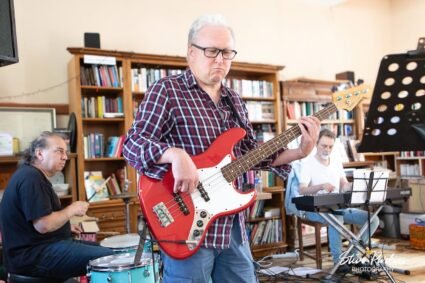
The musicians were exceptional. Every one of them. Bobby Dirninger is Norrie’s favourite keyboard player, and watching the two of them together said everything about why. Aroutian Karapatian held the whole thing together from the drums with a masterful authority that only the finest players possess. David Donachie on bass was exactly what a bass player should be — solid, present, dependable, musical. And Gordon Menditta on saxophone brought colour and warmth to every number he touched.

David on Bass

The audience were magnificent. Their warmth and generosity filled the room as surely as the music did. I watched their faces. The smiles said everything. Those who were there witnessed something genuinely special — the kind of afternoon that doesn’t come around very often, and that stays with you when it does.

Tell it like it is

Thank you to everyone who came. Thank you to Bobby, Aroutian, David and Gordon. Thank you to Andy Berry and the team at La Ruche for opening the doors and trusting us with the PA. Thank you to Steve Parkins for the photographs — they speak for themselves.

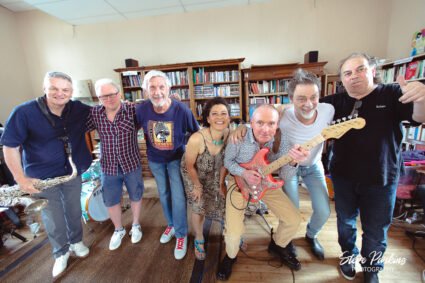
Pure joy on the faces of the band.

And thank you to Norrie ‘Snakebite’ Burnett. For the music, for the friendship, and for showing us all how it’s done.

Still shouting. Long may it continue.